
A set of practical training scenarios with increasing difficulty, with solutions and comments.
Wprowadzenie
ICAO English Language Proficiency (ELP) examinations may vary depending on the aviation authority, testing organisation, or airline conducting the assessment. The format, sequence of tasks, and style of questions are not always identical, but they all evaluate the same core competencies described in the ICAO Language Proficiency Requirements. Regardless of the test provider, candidates are assessed primarily on their ability to understand spoken English and communicate effectively in operational and non-routine aviation situations.
Most ELP examinations include a combination of listening and speaking tasks. Candidates are typically required to listen to ATC transmissions, pilot-controller exchanges, or recorded scenarios and demonstrate that they can accurately understand the information and respond appropriately. Another common component is the picture description task, in which pilots are asked to describe an aviation-related photograph, explain what is happening, identify potential hazards, and discuss possible developments. This exercise assesses not only vocabulary but also the ability to organise ideas, speak fluently, and demonstrate situational awareness.
The interview section usually includes general questions about a pilot’s experience, training, decision-making, safety, and handling of abnormal situations. Examiners are interested not only in the correctness of the language but also in how naturally and confidently candidates communicate, especially when discussing unfamiliar or unexpected topics.
This article provides practical examples of two of the most common ELP examination tasks. The first section demonstrates how picture descriptions develop from ICAO Level 4 (Operational) through Level 5 (Extended) to Level 6 (Expert), highlighting the differences in vocabulary, fluency, accuracy, and depth of observation. The second section presents typical interview questions together with model answers at each proficiency level, allowing pilots to compare the linguistic features expected at each stage and better understand what is required to progress from Level 4 to Level 6.
Part 1 – Describing Pictures (Typical in ELP Test – Picture Description)
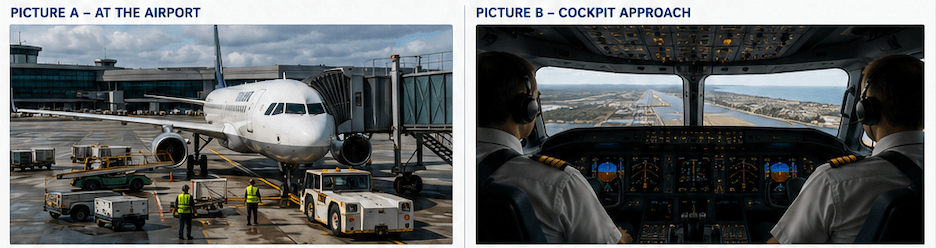
You will see a picture and be asked to describe it in as much detail as possible. You may have time to prepare but you might be also asked to start immediately.
Picture A – At the Airport
| LEVEL 4 – OPERATIONAL | LEVEL 5 – EXTENDED | LEVEL 6 – EXPERT |
|---|---|---|
|
I can see an aircraft at the gate. It looks like a narrow-body plane. There are some vehicles around it. I can see a pushback tug in front. The ground staff are working near the aircraft. The weather is good. |
I can see a narrow-body aircraft parked at the gate with the jet bridge attached to the forward door. A pushback tug is positioned in front of the nose gear. Baggage carts and other ground support equipment are alongside the aircraft, and ground handlers are loading or unloading. The apron looks wet, so it may have rained earlier, but the sky is partly cloudy and visibility appears good. |
The picture shows a narrow-body aircraft at the gate, being prepared for departure or arrival. The jet bridge is connected to the forward left door, suggesting the aircraft is either boarding or deplaning. A pushback tug is attached to the nose gear, ready for towing. Baggage carts, a belt loader, and other ground support equipment are positioned around the aircraft. Ground crew in high-visibility clothing are carrying out their tasks safely. The apron surface is wet, indicating recent rain, but conditions are otherwise favorable with good visibility and no apparent wind. |
Picture B – Cockpit Approach
| LEVEL 4 – OPERATIONAL | LEVEL 5 – EXTENDED | LEVEL 6 – EXPERT |
|---|---|---|
|
I can see two pilots in the cockpit. They are on approach to a runway. The instruments are in front of them. The weather looks clear. |
I can see two pilots on approach to land. The runway is visible straight ahead. They are using the instruments and the autopilot or flight director to stay on the correct path. The visibility is good, and it looks like daytime. There is water near the airport. |
The picture shows a cockpit view on final approach. The aircraft is aligned with the runway centerline, which is clearly visible ahead. Both pilots are wearing headsets and appear to be monitoring the flight displays and outside visuals. The aircraft is likely configured for landing, with the landing checklist possibly in progress. Weather conditions are favorable with excellent visibility, good lighting and calm-looking conditions over land and water. |
Comments – Differences Between Levels
| Level 4 – Operational | Level 5 – Extended | Level 6 – Expert |
|---|---|---|
|
Focuses on obvious, concrete details. Limited use of aviation terminology. Gives basic, simple sentences. Uses everyday vocabulary. |
Adds more detail and some supporting information. Uses a wider range of vocabulary and simple connectors (and, but, so, because). Describes actions, positions and conditions. Some use of aviation terminology. |
Provides a full, well-structured description with precise detail. Shows understanding of the situation, reasons and implications. Uses a wide range of aviation vocabulary and complex structures. Natural flow and effective organization. |
Part 2 – General Questions (Common in ELP Test – Interview/Conversation)
Below are typical questions you may be asked in the interview. Suggested answers are provided for Levels 4, 5 and 6 to show the expected differences.
| QUESTION | LEVEL 4 – OPERATIONAL | LEVEL 5 – EXTENDED | LEVEL 6 – EXPERT |
|---|---|---|---|
| 1. Tell me about your current position. |
I am a First Officer with a regional airline. I fly the ATR 72. I have been flying for three years. |
I am a First Officer with a regional airline based in my country. I primarily operate the ATR 72 on domestic routes. I have been flying for three years, and I enjoy flying and working with my team. |
I am a First Officer with a regional airline operating ATR 72 aircraft on scheduled domestic and short international routes. My role involves safe operation of the aircraft, effective communication with the crew and ATC, and ensuring a high standard of safety and customer service. I have been flying for three years, and I’m committed to continuous learning and professional development. |
| 2. What do you do to improve your English? |
I study English every day. I read aviation articles and watch aviation videos. I listen to ATC recordings. |
I improve my English by studying aviation materials, reading manuals and articles, watching aviation videos, and listening to ATC recordings. I also use English in daily operations and try to speak with native speakers when possible. | I follow a regular study plan that includes reading aviation publications, listening to ATC and pilot communications, and watching English-language briefings and lessons. I practice speaking with colleagues and instructors, review ICAO phraseology, and focus on expanding my vocabulary and pronunciation. |
| 3. Describe a difficult situation you had in the cockpit and how you handled it. |
We had bad weather. There was turbulence. I was busy, but I followed the checklist. We landed safely. |
We encountered strong turbulence during descent. The passengers were worried. I remained calm, informed the crew and passengers, and followed the procedures. We adjusted the altitude and continued the approach. We landed safely. |
During descent through CB activity, we encountered severe turbulence, which caused some concern among passengers. I maintained situational awareness, coordinated with ATC for an altitude deviation, briefed the cabin crew, and communicated clearly with passengers. By following the procedures and working as a team, we ensured a safe approach and landing. |
| 4. What are your strengths as a pilot? |
I am calm. I am responsible. I work well in the team. |
I am a calm and responsible pilot. I work well in a team and communicate clearly. I pay attention to details and always follow procedures. |
My strengths include situational awareness, sound decision-making, and effective communication. I remain calm under pressure, comply with SOPs, and contribute positively to crew resource management. |
| 5. Why do you want to work for this airline? |
It is a good airline. It has a good reputation. I want to grow as a pilot. |
This airline has a good reputation for safety and service. I want to develop my skills here and build my career. | Your airline is known for its strong safety culture, professional standards, and fleet quality. I am impressed by your commitment to training and career development, and I want to be part of a team that values excellence and continuous improvement. |
Comments – Increasing Difficulty
- Level 4 focuses on exchanging basic information using simple language.
- Level 5 requires adding detail, giving reasons and using a wider range of vocabulary and connectors.
- Level 6 expects complete, well-organized answers with precise language, complex structures and clear demonstration of professional judgment.
Remember: In the ELP test, clarity, range, accuracy, fluency, and interaction are assessed. Aim to communicate effectively, using appropriate aviation language and showing good overall communication skills.
For a more detailed analysis of levels and requirements go to ICAO-doc-9835.
Summary
Success in the ICAO English Language Proficiency examination is about communicating clearly, accurately, and confidently in both routine and unexpected situations. As you practise, focus on expanding your observations, organising your ideas logically, and supporting your statements with reasons or explanations. Compare your responses with the Level 4, 5, and 6 examples to identify areas for improvement, and remember that fluency, interaction, pronunciation, structure, and situational awareness are just as important as grammar. Regular practice with picture descriptions, listening exercises, and interview questions will help you develop the confidence and language skills expected of a professional pilot.
Text powered by AI.